
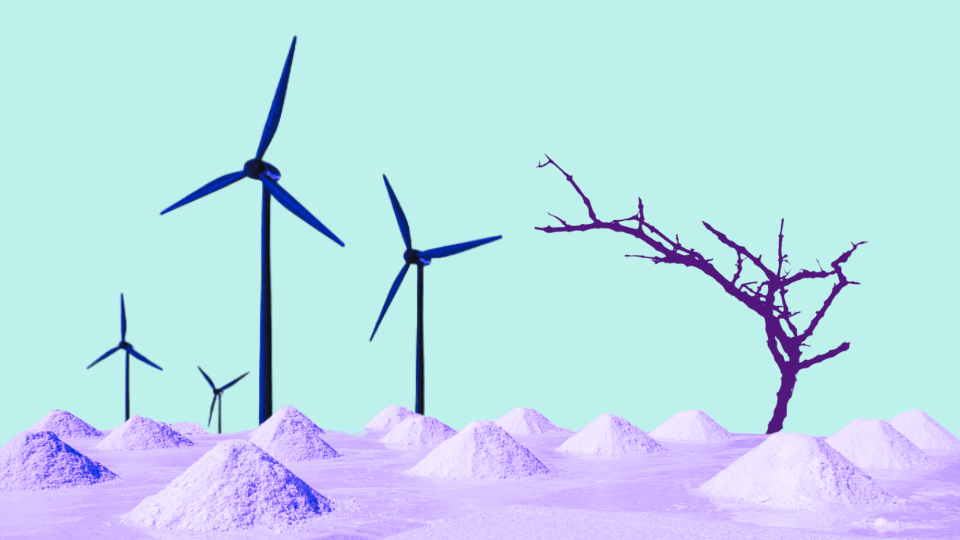
In the context of the current climate crisis, there are different narratives about the need for an energy transition. The scale of the problem means that it is not enough to switch from fossil to renewable energy sources: the energy transition has to go hand in hand with a rethink of our current way of life.
Many experts agree that fossil fuels are irreplaceable due to the energy intensity they produce, and that, for this reason, life and society as we know them today will no longer be possible. The sociologist Maristella Svampa says that fosil fuels will leave a tremendous gap that will affect all social classes (Images of the End, p. 154). We can assume that this process will accentuate existing inequalities.
Fossil: a model, not just a source
While fossil fuels use concentrated energy over thousands of years, renewables use the energy as it comes to us at the moment. This means that to match the power of fossil fuels, much greater deployment is required, resulting in greater pressure on territories.
An example: in one hectare of a plant producing energy, there is a power of the order of one or two hundred megawatts (the one needed to feed a village). In energy production based on renewable energy flows, the energy density is very low: to match this power, a territorial deployment of thousands of hectares is necessary.
Fossil fuels aren´t only a source of energy, but also involve a model of exploitation. It is a centralised sistem, where the production is concentrated, as well as territories and benefits. Those who produce and those who consume are separated, and consumers cannot see (nor question) the impact of that energy production.
The mere substitution of non-renewable sources by renewable ones is nothing more than the continuity of this model, linked to extractivist exploitation, and “is generating unprecedented impacts on the territories” (Campos, 2023).
Partial solutions
Some actors driving the energy transition identify greenhouse gases as the main cause of the climate crisis: in reality, carbon dioxide emissions are a symptom. The disease is the imbalance between the mode of production and the self-balancing of the earth, which cannot process the amounts of CO2 produced by today’s human societies.
In this way, their proposals leave aside environmental and social aspects, such as pollution, loss of biodiversity, inequality and violation of rights. Big enterprises see the energy transition as a possibility to generate a new cycle of capitalist accumulation, with new areas of exploitation.
This energy transition, also promoted by states, institutions and organisations, focuses solely on the technical aspects and the premise of reducing carbon emissions, without worrying about changing the relations of inequality generated by the current model.
For an energy transition, it is necessary to decentralise and democratise energy decision-making processes. Decisions should be taken by the territories, because they are the ones who receive the impacts and who should also receive the benefits.

Sources
-Campos, Álvaro. [Oñatiko Udala]. (3rd March 2023). Critical analysis of the energy transition. [Video].
-Chemes, Jorge and Bertinat, Pablo. (2022, 9th March). Energy transition: from green neoliberalism to popular environmentalism. Agencia Tierra Viva.
-Svampa, Maristella. (2018). Images of the End. Narratives of socio-ecological crisis in the Anthropocene. Nueva Sociedad Magazine, N° 278, November-December (151-164).






 A little fire
Leave a comment