

With a one-week distance, in Australia and Argentina two decisive elections were held this October: the first one has taken place last Saturday 14th, the referendum for the Aboriginal Voice at Parliament; the second one were the presidential elections in Argentina, held on the last Sunday 22th.
A country that does not listen
Almost unanimously Australia rejected The Voice, that only gained a majority in the Australian Capital Territory. What was the proposal about? To establish an independent and permanent advisory body, constitutionally recognised, that would give advice to the Australian Parliament and Government on matters that affect the lives of Aboriginal and Torres Strait Islander peoples. The majority of the population voted No, being 60,8%, against 39,2% for Yes.
However, regions with a high proportion of Indigenous Australians “overwhelmingly voted Yes”, according to the newspaper The Guardian: it says that the Yes vote in polling catchments where Indigenous Australians formed more than 50% of the population was, on average, 63% in favour of incorporating an Indigenous voice to parliament.

After a week of silence to accept the rejection of the majority Australian society, indigenous leaders sent an open letter to the government, where they express their position on the outcome and analise its possible causes. Thus, they say:
“Australia is our country. We accept that the majority of non-Indigenous voting Australians have rejected recognition in the Australian Constitution. We do not for one moment accept that this country is not ours. Always was. Always will be. It is the legitimacy of the non-Indigenous occupation in this country that requires recognition, not the other way around. Our sovereignty has never been ceded.”
At the same time, in their letter, aboriginal leaders analise the political reason for the lose of support for the referendum:
“(It) collapsed from the moment Liberal and National Party leaders, Mr Dutton and Mr Littleproud, chose to oppose the Voice to Parliament proposal after more than a decade of bipartisan support. The proposal was tracking 60 per cent support compared to 40 per cent opposition for several years until the National and Liberal parties preferred wanton political damage over support for some of this country’s most disadvantaged people. There was little the Yes campaign could do to countervail this.”
Behind the No
The No campaing was funded and resourced by conservative groups, and led by senator Jacinta Price, who held that the Voice was going to bring division to the country; among other things, she claimed that colonisation had brought “a positive impact” for the indigenous people.
Also, several media pointed out that there was a disinformation campaign, with false and tendentious information about the Voice, to create doubt and fear in both non-Indigenous and Indigenous communities.
The Voice is a proposal that was born in the Uluru Statement in the Heart, a document shared in 2017 by the First Nations people to non-Indigenous Australians after decades of research, and the initial announcement of the referendum was on the night of Labor´s election in May 2022.
A vote against the right
The presidential elections in Argentina resulted in a second round, where the citizens will have to chose between Sergio Massa (Unión por la Patria – 36,6% of votes) and Javier Milei (La Libertad Avanza – 30% of votes). Also participated as presidential candidates Patricia Bullrich (Juntos por el Cambio, 23%), Juan Schiaretti (Hacemos por Nuestro País, 7%) and Myriam Bregman (FIT-U, 2,67%).
Milei is a far-right candidate whose proposals include the dollarisation of the economy, privatisation of education and health, stripping of labour rights, advancing the victories of women and diversity, and whom, besides, denies the 30.000 desappeared during the last civil-military dictatorship. Different analysts point out that the majority obteined by Massa is due to a vote that tried to prevent Milei´s triumph, despite the fact that Unión por la Patria´s candidate is the current finance minister and the country is immersed in a deep crisis: 40,1% of poverty, the American dollar at about 1000 pesos, 12,4% of inflation during September with an 138% annually, as some indicators.
Although Milei´s proposed policies could have a devastating social impact, an eventual Sergio Massa´s government would be far from a popular project. As current minister he has already sent the 2024 budget to the Congress, that reflects the fiscal deficit goals imposed by the IMF. At the same time, the development model he proposes continues with the primarisation of the economy, that would deepen extractivism and its socio-environmental impact.
Now what?
Facing to the ballotage on 19th November, both candidates spoke in their speeches after the results about the need of leave aside the differences with third political forces. Javier Milei has announced this week an agreement with the former right- wing candidate Patricia Bullrich -who was security minister during Mauricio Macri´s neoliberal government-. On the other hand, Sergio Massa has called to a “national unity government”, regardless of political force.
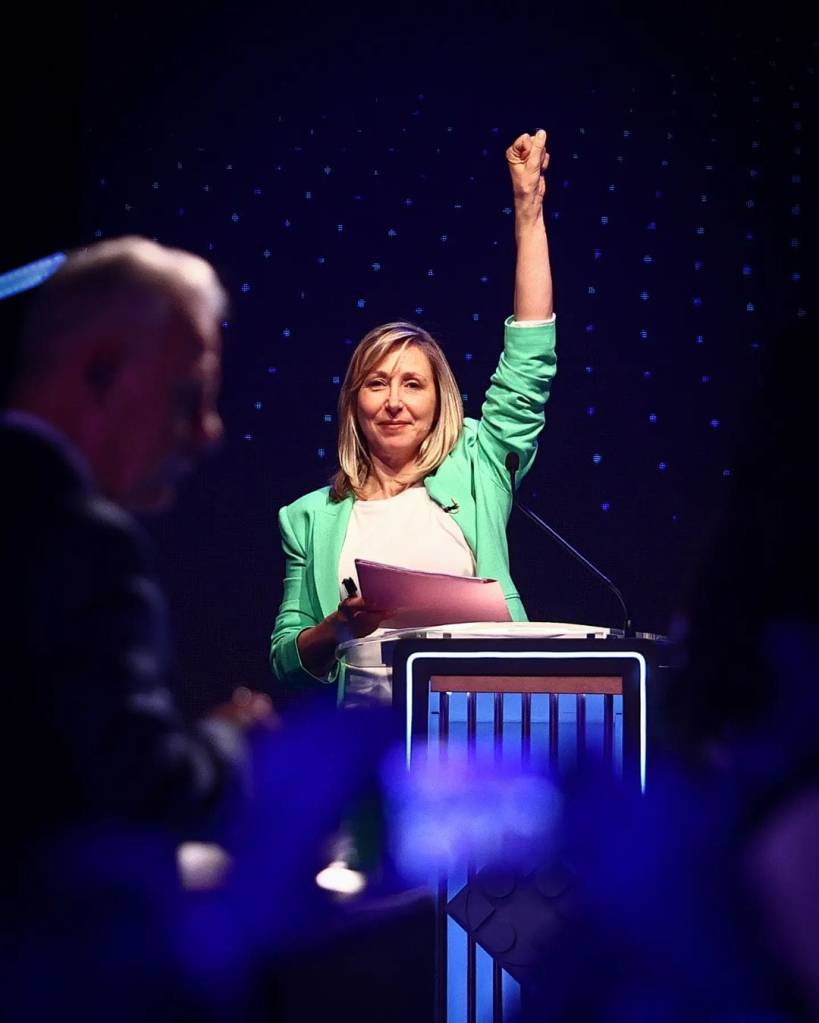
The left-wing party, Left and Workers’ Front-Unity (FIT-U in Spanish), will publish a declaration in the next few days about its position for the ballotage, although they have already announce to the press that they will mantain their political independence, and they won´t vote Milei nor supporting Massa. Its former presidential candidate, Myriam Bregman, is a feminist and human rights lawyer with strong political clarity and ability to make a discursive battle with the right. She helps to keep the last hope alive.
With their enormous differences and specific circumnstances, both elections show the traps of modern democracies in developing political processes capable of articulating projects in wich popular interests and of those who have been excluded from the consolidation of the national states have a place.







 A little fire
Leave a comment