
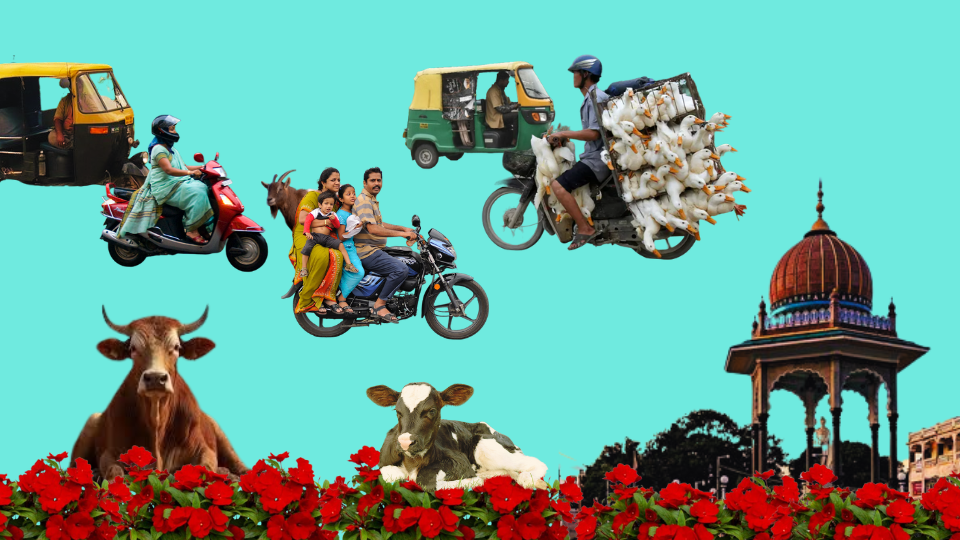
The way of getting the real thing about the places is to spend time there, doing nothing special; just sitting on the street, looking at the people.
Scooters in Mysore can carry the most strage things: gas cylinders; a big pile of carpets full of colours, almost covering the view of the driver; a red parasol; kilos and kilos of bananas; whole families opening their path between the cows and the rigshaws against the flow of traffic. Women dressed in their saris sit by side when are carried behind the driver -they do not put one leg on each side of the seat-.
You may like it: Not only asana. Open your mind as your body.
Besides being a challenge for patience, traffic chaos, somehow, can be the living expression of the cultural network, all the narrations passed by oral tradition: the same overpopulation of stories, characters, ends and whorships. In the present lives something that still remains untouched; in the chaos the beauty of life is expressed.

In this way, Krishna says Arjuna in the Baghavad Gita, one of the most important sacred books in Hinduism: “He who sees Me in all things and sees all things in Me, he never becomes separated from Me, nor do I become separated of him” (6.31); “He who, being stablished in unity, worships me, who I am dwelling in all beings, whatever his mode of life, that Yogui abides in Me” (6.32)
Doctor of Philosophy specialising in Hinduism, Javier Ruiz Calderón, says:

“From a pan-theistic conception of the divine, the one sovereign God -be it Siva, Visnu, Durga or any other- contains within himself the cosmos and the individual souls. Everything exists in God and, ultimately, everything is God. That God is the Lord (Isvara) of the universe, omnipotent and omniscient, creator, preserver and destroyer of all. He does not create out of nothing, but out of His own substance”.
In the middle of the pavement, a calf rests, upright on its bent legs.

Sources
-Ruiz Calderón, Javier. (2008). A brief history of Hinduism. From the Vedas to the 21st century. Biblioteca Nueva Editorial, Madrid.
-Swami Swarupananda. (2020). Srimad Bhagavad Gita. Advaita Ashrama Publication Department.








 A little fire
Leave a comment