
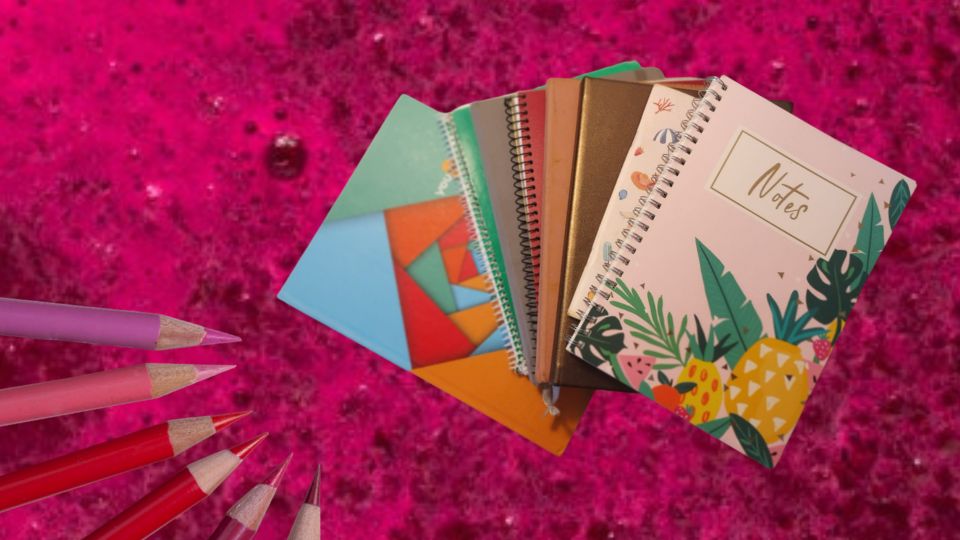
Much has been said about the death of paper with today’s technological transformation. Undoubtably, the explosion of platforms and digital formats has modified the ways we read, and not only that, but the ways we live and make sense, how we create our identity and how we spend our spare time: a report by Social Media Spain published in October 2023 says the average time we spend on the Internet per day is 6 hours and 41 minutes, of which 2 hours and 24 minutes correspond to social media. Whatever, printed formats, like books, magazines and newspapers, have their own defenders and worshippers. The same applies to writing: until now, I hadn’t planned to stop writing in paper notebooks.
Objects and supports
It is said that objects carry an emotional charge that we transfer to them: in the words of researcher Sarah Ahmed, some objects bring with them the promise of happiness. It is interesting to know she identifies family as one of the main objects who regulate social life: “If objects provide the means to make us happy, when we turn towards this or that object we are actually aiming somewhere else: towards the happiness that is supposed to follow from them. The temporality of this relationship is a relevant question. Happiness is that which comes later; hence, it is directed towards certain objects that point in the direction of something else that is not yet present” (Ahmed, 2019, p. 69).
In my case, and coming back to media and supports, I must confess I have a great attachment to my notebooks: maybe because I have disregarded the mandate to raise a family. Word processors are really useful (and at this point irreplaceable) when you are working on a specific project, in a long format. Instead, the intimacy and proximity provided by paper notebooks and the particular experience of writing cannot be supplanted by typing on a keyboard. That´s what I feel for daily writing, that one where you don´t have a specific reader in mind, but only the writing impulse, and that it is free of plans and formats. We can conclude that there are two different formats, that cover two different needs.
In her work, Ahmed focuses on the functioning of affective economies, asserting that emotional traffic regulates the relationship with the environment. Happiness would be a constitutive emotion for the repressive ordering of the normal, with the functioning of emotions as geopolitically situated political cultures.
Today, people place a strong affective investment in digital technology, embodied through a variety of devices, especially mobile phones. Javier Serrano Puche says in his text “Internet and emotions”: “To become aware of the capabilities of the digital environment as a space and a channel for the expression of emotions means considering the Internet and its applications not as an instrument that we use, but as a place of experience and subjectivation; instead of a communication media, it is a space that we inhabit and that inhabits us” (2016, p.22).
At the same time, the technological giants ended 2023 with record profits, and so far in 2024, these companies have led stock market rises: Alphabet increased 5,3%; Apple, 2%; Amazon, 13,7%; Microsoft, 11,6%; Meta, 35,6%; and Nvidia, 45,5%.
Up to the cloud and beyond
Anyway, weight and volume are big drawbacks of paper. Since many years ago I have thought very carefully before buying a book, because boxes with books are the most heavy items in removals – as I haven´t had my own fridge since my last house in my hometown, nine years ago.
But writing in notebooks is deeply ingrained in my affective economy; my private writing helps me to regulate my emotions and organise my thoughts: and all this happened on paper until now. They are with me where I go, at the bottom of my bag, on the light table: I have written in notebooks since I was 16 or 17 years old – almost twenty years!
What to do with the living testimony of my most intimate desires, of my frustrations, of my ramblings and of my games with writing? Everything is there on those pages. More than one hundred notebooks are in boxes in my mum´s house, as hidden as I could leave them.
I hadn´t rethought this habit until now, that I had left Argentina and when I moved, I had to carry my notebooks. I decided to come to Sydney to further develop my professional career in communication. But arriving with a box full of my paper friends was inconvenient and stressful, as my luggage was overweight, and I had to reorganise myself before being able to board the plane.
I believe it is time to acquire a digital smart notebook, that imitates the experience of writing on paper, and keeps your texts saved in a cloud. And embrace the benefits of changes in the way we write and manage our intimate lives.
Meanwhile, I am thinking about what to do with the 2.5 kg of notebooks I have accumulated, so as not to send them in a parcel (it is not too easy from here to my country). First taking the job of scanning them and creating a pdf file with each one; and after that? Cutting them into small pieces and making recycled paper for donations? Burning them in a bonfire in honour of my love of writing? To make compost for the little orchard and other plants in the backyard?
If you have any better ideas, please leave them in the comments.
PD: Sorry for the links in Spanish, you are invited to translate them with your browser.

Sources
-Ahmed, Sarah. (2019). Caja Negra Editora, Buenos Aires.
-Serrano Puche, Javier. (2016). The Internet and emotions: new trends in an emerging field of research. Comunicar Magazine, pps. 19-26.






 A little fire
Leave a comment