
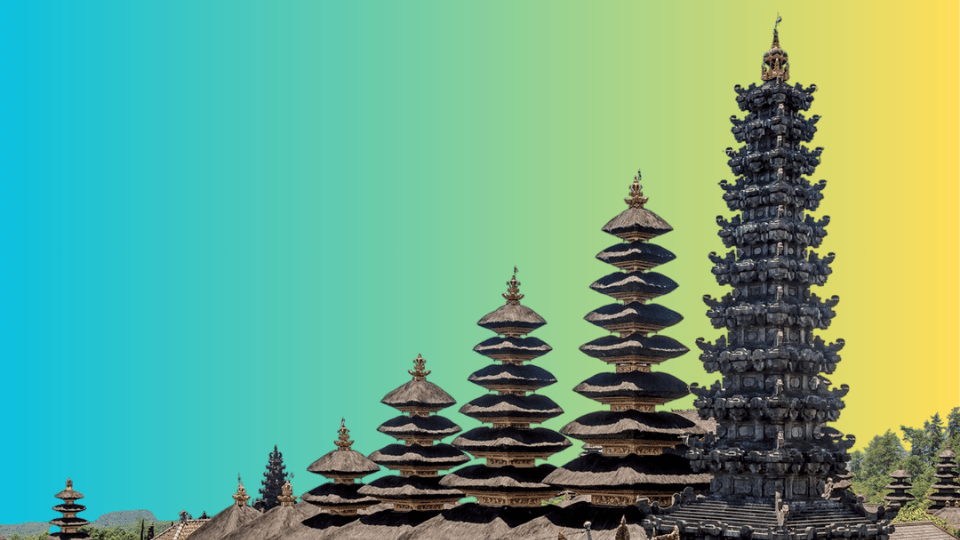
Besakih is the main, oldest and holiest Hindu temple in Bali, among the more than 10.000 temples that exist on the island. Located on the slopes of the volcano Agung, it was founded in the VIII century by Rsi Markandeya, an East Indian priest who spread Hinduist teachings on the island, although it is considered a sacred place from ancient times.
The main features of Balinese Hinduism
In Bali, most people are Hindu (about 90%), whereas the other islands of Indonesia are mostly Muslim (approximately the same percentage). Balinese Hinduism has some differences with the one that is practiced in India, and it is mixed with previously existing local traditions. In this way, the cult to the gods goes together with devotion for ancestors and protector spirits. These three things together (gods, ancestors and spirits) are called Trihitakarana, and it is part of an ancient philosophy that states harmony with gods, nature and people as a way of living.
In Balinese Hinduism, people do not follow only one worship to a specific god, but they pray for all Hindu gods: the trinity Brahma-Vishnu-Shiva and other minor gods. They also have a supreme god called Shang Hyang Widhi Wasa, and they carry out a series of daily ceremonies to thank the rain, the sun, the wind, and others.
Pura Besakih
Besakih has three main temples dedicated to the Hindu trinity: Pura Penataran Agung, in the centre, is dedicated to Shiva, the destroyer, and it has white banners; Pura Kiduling Kreteg is for Brahma, the creator, set at the right with the colour red; and Pura Batu Madeg, at the left, represents Vishnu, the preserver, with its black banners.
However, Pura (temple) Besakih is a complex of 46 large and small temples, and besides the temples dedicated to the trinity, there are others for the protector spirits and for the ancestors. These last ones are separated according to the caste system, and every caste only has permission to pray in its own place: that means, temples for shudras (peasants and workers), vaishyas (merchants and farmers), ksatriyas (warriors and rulers) and brahmans (priests and masters).
The description is not intended to be exhaustive and it is mainly based on the guide’s words. If you want to know more about Pura Besakih, you can check this web, which has a lot of information.
The visit to the temple

The place has a strong energy and visiting it gives you a deeper understanding of local culture and history. People who are menstruating are not allowed to get into the temple, but they do not check it in any way. With your ticket they assign you a guide and give you a sarong, special clothes that everyone must wear when getting into a temple. The guide keeps only 2 USD of the total cost of the ticket for foreigners, about 10 USD.
When I went the tour was short, only around the main temples; however, reading a bit for this article I found that the circuit was longer before. So if you get there, ask your guide to take you to the smaller temples around.
How to get there
Getting there from Ubud is about 50 kilometres. In my case, I had read in travel blogs that the way was a bit hard and decided to go with a driver, instead of renting a scooter, which is considerably cheaper (and more autonomous). It was still rainy season in Bali and I didn’t want to risk having a bad time.
However, the route the driver took looked safe for riding a scooter, although it goes up the mountain. It is a different way than the one Google Maps showed me when I was deciding how to get there (that I think is the one the people I read took).
So, here´s what the driver did: go all the way from Ubud to Semarapura, taking the route that goes to Goa Gajah; once close to Semarapura, take any of the roads that go to the north (he took one in the first way and another to return, so it should be the same): Jl. Raya Banda and Klungkung-Besakih road; then take the corresponding detours to Besakih. It should be about 1.30/2.00 hs each way by scooter.






 A little fire
Leave a comment